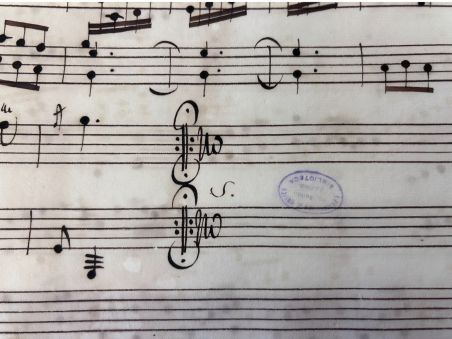
Águeda Pedrero Encabo has shown that court copyist José Alaguero was responsible not only for the Parma and Venice sets, but also for four other Scarlatti sources and the works of his finest epigone, Sebastián Albero. Many aspects of Alaguero‘s work are somewhat inconsistent. One example is the appearance of small markings in many sonatas in Parma XIV (1756) and XV (1757), the last volumes of the primary source.* One finds S., S: and SA., mostly at the end of pieces, but also at a few double bars (similar to the French reprise) and one change of meter. These have excited much speculation; were they the initials of the mysterious copyist, possibly Sebastián Albero or Antonio Soler?
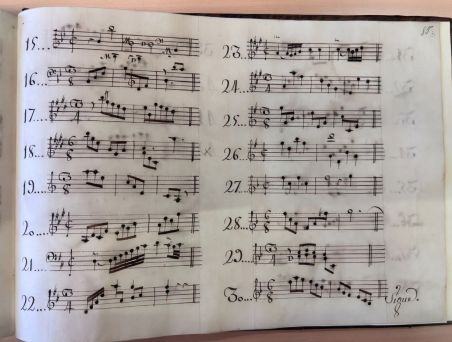
Nothing so dramatic: they are abbreviations for “Segue" or "Segue Allegro". Beginning at around the same time, Alaguero wrote out the words in full at countless locations in his copies of vocal works, and in one telling location in Parma XV as well. In the index at the end, added after no. 30 (which would normally have been the final sonata, as it indeed is in the corresponding Venice XIII), “Sigue" announces 14 final sonatas on the next page. That number, representing the last pieces Scarlatti sent to his faithful copyist in the year of his death, was insufficient for another volume in the queen‘s set, but they were made available to others. The word doesn’t mean “continue immediately” as it would later, but simply “there is more”.
Writing “S[i]egue” apparently became such an automatism around 1756 that Alaguero from sheer force of habit added the abbreviations to around half of the sonatas in his two last volumes for the Parma set.** In his earliest recorded copies for a vocal work (instrumental parts for three intermezzi, 1748), they are absent. Instead, da capo or dal segno appear after almost every movement. A similar act of habit probably led Alaguero to add “D.C.” at the end of almost every sonata in the the 1742 and 1749 Venice volumes which were prepared for the queen (perversely catalogued as XIV and XV). Some of their contents, partially revised and with “D.C.” eliminated, were later included in the Parma set, which I think was Scarlatti’s personal archive.
The markings appeared lighter and sketchier than anything else in the two Parma volumes when I viewed them at the Biblioteca Palatina in May 2026. This led me to an hypothesis: the ailing Scarlatti had checked some of the sonatas and approved them – rather like the way Shostakovich initialed some pages of his largely faked autobiography. It was Prof. Pedrero Encabo who brought me down to earth with the correct suggestion, which I confirmed by searching the Alaguero manuscripts available online at Real Biblioteca Digital (rbdigital.realbiblioteca.es , search “Alaguero”).
*Joel Sheveloff’s dissertation was the first to note these markings in Parma XV, but he apparently missed their appearance in XIV. I haven’t found any reference to the latter in the literature, but that could be due to laziness.
** S and SA don’t appear in the queen's subsidiary parallel copies, Venice XII and XIII.
June 4, 2026
“Sigue” on page 2 of the index of Parma XV, leading to the final 14 sonatas.
Ending of K 538, Parma XV.
|