In 1659 a Bloemkrans van verscheidenen gedichte (“Bouquet of Diverse Poems”) was published in Amsterdam. At nearly 700 pages, it is the largest Dutch poetry anthology of Holland’s Golden Age, the 17th century. It contains three poems by Jo(h)an Dullaart, dedicated to as many musicians, which offer fascinating ear-witness accounts of some of the best in the field.
An excerpt from one of these poems appeared in the first issue (1872) of the journal of the Society for Netherlands Music History (Vereeniging voor Nederlandsche Muziekgeschiedenis), called Bouwsteenen. These “building blocks”, edited by Jan Pieter Heye (or Heije) – a forgotten poet who has a street named after him in every Dutch city – represented the first concerted effort at documenting the music history of the northern Netherlands. Heye’s editorial is a remarkable document which expresses a mixture of intense shame and pride; shame that nearly everything regarding the great Dutch masters of the past had been forgotten in their native land, and pride at what had been recovered in the past few years (with considerable help from Robert Eitner). The article on Jan Pieterszoon Sweelinck was a sensation; it revealed for the first time the existence of most of his vast oeuvre. Alan Curtis footnoted the source in his book on Sweelinck’s keyboard music. During the writing of Article 168, John Koster pointed that out to me, and I started a round of Googling, with the following result.
The longest of Dullaart’s three poems deals with a young organist of Rotterdam, Jo(h)an Crabbe. He was the son of Jacob Jansz. Crabbe, city organist of Alkmaar, who was one of the instigators and examiners of the famous Hagerbeer organ there. The inauguration party on August 30, 1646, was attended by Sweelinck’s former pupil Pieter de Vois as well his son Dirk, J.B. Verreid or Verreit, and Cornelis Jansz. Helmbreeker, all mentioned in the poem, as is Crabbe père. Also present was Jacob van Campen, architect of the incomparable new City Hall in Amsterdam. Crabbe fils was appointed to the organ of St. Lawrence in Rotterdam in 1657.
I can generally pass for a native Dutch speaker, but I think even scholars might stumble over some of Dullaart’s bloemrijk language. With this caveat, here is the text of Dullaart’s poem in translation.
To the Spirited and Artistic
Mr. JOAN CRABBE,
ORGANIST OF ROTTERDAM.
When your well-trained hand
Leaps upon the keys and stops,
Church, vault, and choir stand ablaze
By the fire that surges from the pipes;
The organ glows as if aflame;
Stalls, pews, and portal,
Pillars and tombs, cold and damp,
All glow and burn, every one.
Yet not with a consuming fire,
But with that which burns within your spirit,
Which, through its divine grace,
Leaves us mute and rigid as marble.
When you draw forth five-and-twenty pairs
Of registers from the organ,
Where each in turn, coming and going,
Offers us a distinct and different tone —
Then one hears the harp, the viol, and the lute,
The trumpet, shawm, and bugle,
The lyre, the Hol-pijp, the Cijtter, and the flute,
The nightingale, the Cimbaal, and the cornet.
And many other tones besides,
Artfully interwoven,
Which, like clear summer weather,
Refresh the heavy human heart.
How sweetly, how lovingly your hand caresses
Each key, each stop, each full measure!
How purely and nobly your tremulant resounds
In the ear of one who understands the art!
You decorate Sweelinck’s noble flair
With your Psalms so clever in their haste,
And in such manifold ways
That discerning ears stand utterly amazed.
Your father Krab, de Vois, Verrijt,
Hellembreker, and Van Noord,
To the regret of two rival cities,
Are heard in your actions.
Had the Spaar[ne] ruled justly,
Its organ would have been awarded to you;
And how the matter was settled in Den Bosch—
O skillful Krab—need not be said.
You drive sorrow from the heart,
Within the vaulted nave of Saint Lawrence,
And heal, through your organ-playing, the grief
Of the most sorrowing and mournful soul.
Were it permitted to the dead,
They would rise, at your ringing sound,
Like the Phoenix from its ashes,
Out of their grim dark graves.
I foresee the stalls, the choir, and the nave,
Ere long, so filled with people,
That the church itself will prove too small
For the crowds you shall draw there.
Who, then, in this drab wintertime,
Would wish to huddle in silence by the hearth?
Or to spend his time in idleness,
Lingering with this or that drunken innkeeper?
The spirit, the art, and the learning
Of Frescobaldi and Libert[i],
These I hear in you, O young Krab,
When you challenge the lyre of Phoebus.
How flatteringly you emulate the son of Jesse,
Through organ pipes of ringing voice!
How you vie with Scheidemann for the crown,
And rival ancient Jerusalem,
With tones [like those] that made Jehovah’s praise
Resound upon the strings of David
Within the thrice-holy sanctuary,
Where the high priest offered incense all alone.
O CRAB, thou art the source of the arts;
If thus thou didst blaze forth in thy dawn,
How, then, shall thy sun blaze
When it stands at high noon?
The poem is hardly more than doggerel, in “common meter” of iambic tetrameter in alternating rhyme. Jo(h)an Dullaart is remembered as a minor dramatist, but he clearly knew something about music. St. Lawrence was, and still is, the major Gothic church of Rotterdam, in front of which stands the masterful, constantly vandalized statue of Erasmus by Hendrik de Keyser. I pulled stops and turned pages for my teacher Gustav Leonhardt at the new organ built after the church’s destruction by the Germans in the infamous air raid of 1940. Crabbe’s organ stood in the same location; it was built shortly before this poem was composed, by Hans Goltfuss in 1644. The advisor was the Libert[i] mentioned in the poem, about whom more in a moment.
A few notes might be helpful. The list of instruments presents some difficulties which I have left in Dutch. The holpijp was an organ stop of wide scale, either wood or metal, open or covered. According to “New Grove”, even the original meaning of the word is unclear, so precisely what instrument Dullaart may have been referring to is a mystery. Cijtter opens a minefield of plucked- or hammered-instrument possibilities, any one of which it is difficult to imagine being rendered on an organ. Cimbaal falls into the same category; (clave-)cimbaal (harpsichord)? Cymbals? Bells? What organ stop could Dullaart have been referring to in that pre-electronic age?
The reference to Sweelinck is tantalizing. It could refer to Jan Pieters, but I doubt Dullaart would have had much knowledge of him or his work. Son Dirk had only died in 1652. “Decorate” is my rendering of breekt op; to “break up” into runs in fast note values which the English called “divisions” and the Germans Colorieren is my best guess as to the meaning.
The list of stylistically-similar or model organists includes the most famous in the land. Crabbe’s father has been discussed. Pieter de Vois was a blind student of the elder Sweelinck, a Catholic as was (in all probability) his teacher. He played violin to the master’s harpsichord at Amsterdam city festivities. He was invited to succeed Sweelinck at the Oude Kerk, but elected to stay at St. Jacob in The Hague, where he taught harpsichord to the statesman and polymath Constantijn Huyghens. De Vois was one of the advisors for the construction of Crabbe’s organ at Rotterdam.
Jan Baptist Verrijt (variant spellings) was active in several cities before becoming titulaire of the great organ at Den Bosch. To get up to the mark at the carillon he was sent to study with Jacob van Eyck in Utrecht. His final job was in Rotterdam as Crabbe’s predecessor.
Cornelis Helmbreeker was another student of J. P. Sweelinck. His career reached its pinnacle with a long tenure at St. Bavo’s in Haarlem. The burgomasters expressed their satisfaction with their man by paying for a painting on his private harpsichord.
Van Noord could refer to either Jacob – at the time organist of the Oude Kerk in Amsterdam – or Anthoni of the Nieuwezijds Kapel. Anthoni’s collection of Psalm settings appeared in the same year as the Bloemkrans.
The references to the Spaarne (the river of Haarlem) and Den Bosch indicate that Crabbe was passed over for the successions there. But Dullaart thinks that the “two rival cities” are sorry they erred in their appointments.
His mention of Frescobaldi is striking. The dominant figure in Italian keyboard history died in 1643, and his reputation was pan-European. He had visited the southern Netherlands as a young man in the entourage of a patron. That he is connected to one “Libert” in the poem could be significant. Hendrick Lubberts of Groningen in the far northern Netherlands at some point changed his nom d’artiste to a franco-italianate Henri Liberti. He was a choir boy at Den Bosch, before settling as a chorister in Antwerp. There he studied organ with no less a personage than John Bull, becoming his successor at the cathedral when Bull died in 1628. An 18th-century biographer called him le plus habile organiste qu’il y eut alors à Anvers. Some of his works were published by the pre-eminent house of Phalesius.
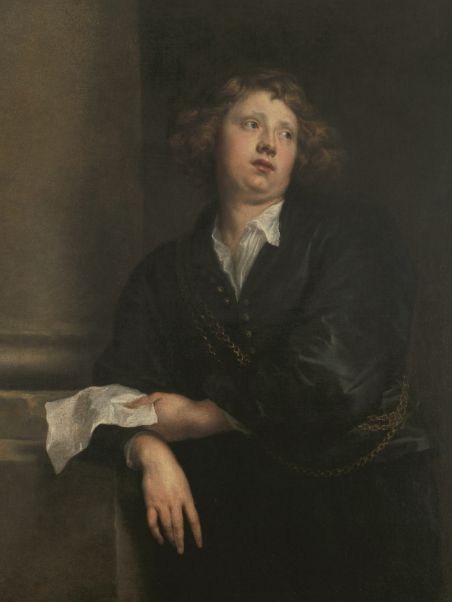
Liberti’s stunning portrait (see below) by Anthony van Dyck sold for nearly £3,000,000 in 2014. It was engraved by Pieter de Jode for the painter’s Icones Principum Virorum (1645-6), and is now at the Phoebus Foundation in Antwerp. Their head of research, Dr. Leen Kelchtermans, recently found notarial documents concerning Liberti/Lubberts, one of which documents a dispute regarding harpsichord lessons which were to have been given to the son of a prominent citizen in exchange for two paintings
(phoebusfoundation.org).
Dullaart then passes from the lyre of Phoebus (“bright” Apollo) to that of the “son of Jesse”, King David of Israel – but not before taking a detour to Hamburg. Heinrich Scheidemann, organist of St. Catherine’s in the city on the Elbe and Alster, was the most important of Sweelinck’s many German students. His successor there was a Dutchman, J.A. Reincken of Deventer, who famously encountered J. S. Bach in 1720. That Scheidemann (1596-1663) should be regarded as currently holding the crown among organists in a Dutch poem of 1657 or thereabouts is testimony to contacts between Free Imperial Cities and members of the Hanseatic League. “The strings of David” are, of course, the harp with which the old rogue was thought to accompany the Psalms attributed to him.
Moving on to the second of the three poems, we come to Jacob van Noordt (1616-80), Dirk Sweelinck’s successor at the Oude Kerk. He is probably the van Noordt mentioned in the previous poem, since he had a far more important organ in his care than his younger brother Anthoni; but it is the latter who is more significant to music history because of his 1659 print of Psalm settings for keyboard – one of pitifully few Dutch sources for the 17th century. Here is the poem for Jacob:
On the Carillon of
Mr. Jakob van Oort
O Jakob, who while crowned with palms
Not only charms the ivory flute,
But [also] in God’s church blows the shrill voice
Of the organ with lofty echos –
You set my spirit all aflame with inward joy,
When, from the tower of the Exchange,
You let your carillon, in a savor of heaven,
Be heard by the youth of Amsterdam.
All the spirits from the Elysian Fields,
All the superb nightingales
That dwell in pleasant Tempe’s groves,
Come down to perch in Amsterdam’s lindens.
You make them, by the sweetness of the sound
Of your bells and organ-pipes,
And of your clear-toned ivory flute,
So tame that anyone might grab them,
As they sit there as if in a dream.
You, with your strings so pure of soul,
Calm the raging, furious surge
Of the IJ and the Amstel’s stream;
The merchants on the wealthy Exchange,
Whom baleful anxieties for their goods
Nearly suffocate, their hearts full of grief –
These you can revive with your playing,
As a young shoot of spring is refreshed
By a morning fall of rain.
O Jakob, glory of my lute,
May Heaven pour down its blessings upon you;
And grant that you for many a year
May bind our hearts fast to your lyre,
Until the joyful host of Heaven
Where David strikes his harp
Shall lead you home.
This shorter opus requires only a few notes. The Exchange on the Dam, built in 1611 by the same Hendrik de Keyser mentioned in connection with his statue of Erasmus, was the world’s first purpose-built stock exchange. The preservation society named after him is housed in the building where Gustav Leonhardt lived from 1970 until his death.
My opting for “spirits from the Elysian Fields” is a bit of a stretch; Dullaart writes “angels on the plain of heaven”, but I can’t make any more sense of it than that. It fits in with the Vale of Tempe, home of Apollo and the Muses. Continuing in the same vein, the probable neologism of zielzuivere strings surely refers to van Noordt’s metaphorical lyre, which appears explicitly four lines before the end. Dullaart modestly gives himself the more prosaic lute.
His third poem is dedicated to the only one of the musicians who is remembered today. Jonkheer (a title of minor nobility, cognate to the German Junker) Jacob van Eyck (ca. 1590-1657), blind from birth, published his enlarged Fluiten Lust-hof in 1649. This big collection of variations on popular tunes is a mainstay of recorder players all over the world. One of his contractual tasks in Utrecht was to play his recorder in the churchyard of St. John’s “for the strolling folk”. But in his lifetime van Eyck was better known as a carillon player, technician and bell-casting expert. The mighty tower of Utrecht’s former cathedral still holds the instrument that succeeded the one played by van Eyck, cast in 1664 by the Hemony’s, whom van Eyck taught how to tune their bells.
To the Hon. Jonkheer Jacob van Eyck:
On the elegant rendering of his Fluiten Lust-hof
Zephyrs, who oblige us to hear
The clanging of cymbals,
Listen [rather] to van Eyck, who coaxes to Utrecht
Forests full of nightingales,
Which, with the sweet sound
Of his bells and organ pipes,
He lures, so close that he could almost seize them.
Crown, then, his sweet flute,
Upon which measured fingers dance,
With consecrated laurel wreaths.
Could his noble eyes but see,
He would play in double strains
Upon Euterpe’s stage of praise;
But since the gods denied him sight,
He rises, blind, upon his wings,
Like a Phoenix among the birds,
Higher than any [other] man may attain;
A double Orpheus, could he but see.
This effort by Dullaart is the most far-fetched of the three. The Simbalen referred to here must be the noisy, percussion kind. He repeats the image of nightingales lured within grasping distance, as well as the Phoenix. Euterpe was the Muse of lyric poetry and of the aulos, thought at the time to be a double flute; hence the reference to “double strains”, itself doubled in the last line. I wondered if the metaphor of van Eyck rising, as it were, “on wings of song” was proto-Heine, but AI informs me that it already appears in Pindar and Plato. So much for my knowledge of the Classics.
The most interesting aspect is Dullaart’s reference to the “sweet sound” of van Eyck’s bells and organ pipes. I was at first puzzled, since I knew him only as a recorder and carillon player, not as an organist. He had a baton keyboard at home for practice and teaching purposes, rather like the pedal clavichords of Germany. But I was ignorant of his work as an acoustician. I mentioned his bell-tuning above, but because of his acute sense of hearing he was also called as a consultant for the purity – the “sweetness” – of organ pipes. Thus he was summoned to Amsterdam in 1655 to judge the spectacular new organ at the Nieuwe Kerk.
This leads me into a closing digression. Gustav Leonhardt played the last concert on that instrument before it was shut down for a major restoration, and the first after its completion. The latter performance was in his capacity as city organist, thus as a kind of successor to Sweelinck. I was visiting the family one day when I expressed a desire to see the instrument up close. Zo gezegd, zo gedaan. We got up from the kitchen table, and he took a ring of heavy old keys from a cupboard. We put on our raincoats and strolled from Huis Bartolotti on the Herengracht over to the huge stump of the never-finished tower, where a secret entrance led up to the loft.
The first act was opening the wing doors, both hoofdwerk and rugwerk, painted by van Bronkhorst. They kept dust out of the magnificent case, designed by the same Jacob van Campen who attended that inaugural party in Alkmaar. Leonhardt mildly cursed the electro-pneumatic operation; he thought moving them by hand would be so much more satisfying. Then came an impromptu tour of the stops by the great improvisor. I pulled some of the levers so that I could feel the weight of the spring chest in operation – a complex system that provided tighter seals, but was a nightmare to repair.
It was the work of Hans Wolff Schonat, a Thirty Years War refugee from my present home in Franconia. He worked from Haarlem, then the nexus of organ building in the northern Netherlands. As an apprentice, Schonat formerly travelled from his home in Windsheim to the workshop of his Meister in Lohr along the Alte Landstraße, at the time the rough-paved superhighway from Vienna to Frankfurt, now no more than a country lane that peters out in barley fields not far from my house. I sometimes walk out there and kick up the old stones, over which travelled Orlando di Lasso, Andrea Gabrieli, Froberger, most of the Habsburg emperors on the way to election in Frankfurt, and who knows who else. Not Mozart, sad to say. Traffic was rerouted just a few years before his only passage through Würzburg. But there is an old stone bridge near our supermarket which bore his post-carriage for a few seconds.
17 May, 2026
Hendrick Lubberts / Henri Liberti by Anthony van Dyck (courtesy of the Phoebus Foundation, Antwerp)
|